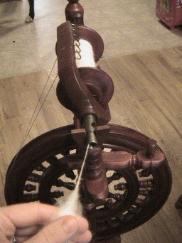
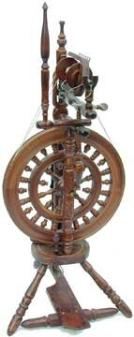
| Time to Spin the Wool. This type of spinning wheel is called a castle wheel or parlor wheel. It's a type of flax wheel that's light and easy to carry around. The spinner turns the pedal and frequently makes adjustments to the wheel to ensure that the wheel spins the thread evenly. You can see that the spindle on a flax wheel isn't sharp at all (look where the thread is coming out.) Nowhere for Sleeping Beauty to prick her finger! The fiber is spun into thread, and then the thread wraps itself around the bobbin. |
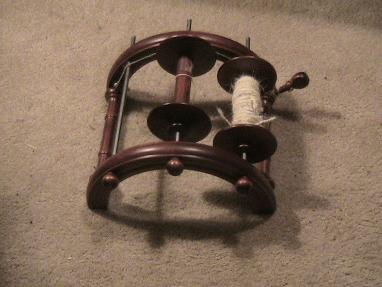
LAZY KATE After the
spinner spins the thread, she
may put the bobbin of thread
onto a Lazy Kate (right).
When she's spun two or more
bobbins of thread, she may
re-spin the thread backwards
to twist two threads together
to make a two-ply (or more)
yarn. The Lazy Kate holds the
bobbins and makes the
process of making multi-ply
thread easier.
spinner spins the thread, she
may put the bobbin of thread
onto a Lazy Kate (right).
When she's spun two or more
bobbins of thread, she may
re-spin the thread backwards
to twist two threads together
to make a two-ply (or more)
yarn. The Lazy Kate holds the
bobbins and makes the
process of making multi-ply
thread easier.
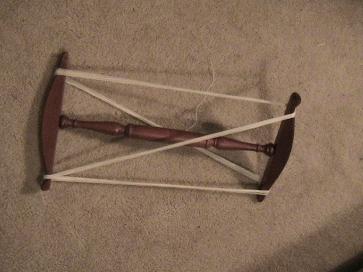
The niddy-noddy: After the thread is
spun or plyed, it's make into a long
loop called a hank by wrapping it
around a niddy-noddy (left) or putting
it onto a clock reel.
The hank of thread is usually wetted
and then hung to dry with a weight
attached to one end to help "set the
twist." The hank of yarn may also be
washed, bleached or dyed.
spun or plyed, it's make into a long
loop called a hank by wrapping it
around a niddy-noddy (left) or putting
it onto a clock reel.
The hank of thread is usually wetted
and then hung to dry with a weight
attached to one end to help "set the
twist." The hank of yarn may also be
washed, bleached or dyed.
CHARITY says, "Textile production used to be a constant job for women.
Some people said that it took 7 carders to keep one spinner busy and 7
spinners to keep one weaver busy. What a lot of work!"
Some people said that it took 7 carders to keep one spinner busy and 7
spinners to keep one weaver busy. What a lot of work!"
Technically, a hank of worsted-wool
yarn should be 560 yd long. A hank of
cotton is 840 yards long.
yarn should be 560 yd long. A hank of
cotton is 840 yards long.