How this Research Came To Be
Like most girls in north Louisiana, I grew up riding Western. Riding
was a necessity, rather than a sport or luxury, for rounding up cattle. I
knew about aside riding from my great-grandmother, though, and
sometimes would put my leg around the horn of my Hereford saddle
and see what it was like.
In graduate school at the Museum of Texas Tech University I finally
got my chance to explore my interest in sidesaddles and aside riding. I
was able to buy my first rideable sidesaddle, and I also had access to
an excellent library and archives. I intended to complete a thesis on
sidesaddles and aside riding as part of my Master's degree in
Museum Science. An empolyee at the museum rode aside, and we
sometimes went riding together.
Like most girls in north Louisiana, I grew up riding Western. Riding
was a necessity, rather than a sport or luxury, for rounding up cattle. I
knew about aside riding from my great-grandmother, though, and
sometimes would put my leg around the horn of my Hereford saddle
and see what it was like.
In graduate school at the Museum of Texas Tech University I finally
got my chance to explore my interest in sidesaddles and aside riding. I
was able to buy my first rideable sidesaddle, and I also had access to
an excellent library and archives. I intended to complete a thesis on
sidesaddles and aside riding as part of my Master's degree in
Museum Science. An empolyee at the museum rode aside, and we
sometimes went riding together.
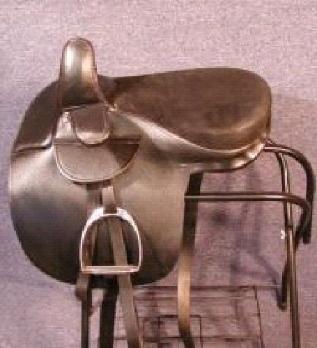
| Parts of the Sidesaddle |
Seat
2nd Horn
Leaping Horn
| Cantle |
Pommel
Safe
Stirrup
Tree: The wooden or fiberglass foundation
on which a saddle is built.
The First Horn (found on some older
saddles) is not visible in this photo
Note: Not all sidesaddles had a leaping
horn. "Two horned" sidesaddles (with the
leaping horn) were made into the 20th
century, and were relatively cheap.)
The girth is the band that goes around the
horse's chest or belly to secure the saddle. A
balance girth is a diagonal band found on
the off-side of some park/level-seat type of
sidesaddles.
Planchette: The wooden footrest found on
medieval and Renaissance sidesaddles.
Slipper Stirrup: a stirrup that is shaped
rather like a house-slipper or mule. The
enclosed toe portion prevents the rider's foot
from slipping through the stirrup.
on which a saddle is built.
The First Horn (found on some older
saddles) is not visible in this photo
Note: Not all sidesaddles had a leaping
horn. "Two horned" sidesaddles (with the
leaping horn) were made into the 20th
century, and were relatively cheap.)
The girth is the band that goes around the
horse's chest or belly to secure the saddle. A
balance girth is a diagonal band found on
the off-side of some park/level-seat type of
sidesaddles.
Planchette: The wooden footrest found on
medieval and Renaissance sidesaddles.
Slipper Stirrup: a stirrup that is shaped
rather like a house-slipper or mule. The
enclosed toe portion prevents the rider's foot
from slipping through the stirrup.
As fate would have it, I ended up doing an internship rather than writing a thesis. For almost a
decade, my research on sidesaddles sat in a closet gathering dust.
Now I've brought my research out from the boxes. This brief article is intended for young people
and aside beginners. More advanced researchers will want to look at my bibliography (sorry, it isn't
correctly formated.) NOTE: Aside terminology differs from resource to resource, especially
between American and British books. Also, sidesaddle types have only recently been named, and
authors differ in what particular saddle-types are called.
Hope you enjoy studying this fascinating artifact: the sidesaddle!
decade, my research on sidesaddles sat in a closet gathering dust.
Now I've brought my research out from the boxes. This brief article is intended for young people
and aside beginners. More advanced researchers will want to look at my bibliography (sorry, it isn't
correctly formated.) NOTE: Aside terminology differs from resource to resource, especially
between American and British books. Also, sidesaddle types have only recently been named, and
authors differ in what particular saddle-types are called.
Hope you enjoy studying this fascinating artifact: the sidesaddle!
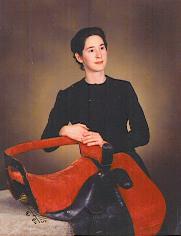
| Me in my habit with the YR saddle (see below). |
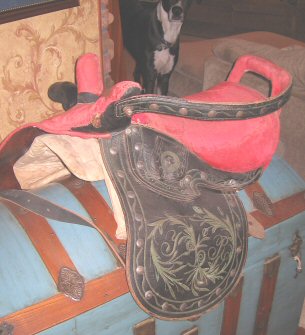
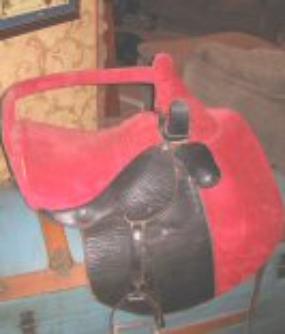
BELOW: The "YR" saddle c. 1865 or earlier.
Most sidesaddles are made so that the rider's
legs are on the near (left) side of the horse. A
few saddles, like mine, are "off-sided" (right
side). My YR saddle was probably custom
made. It's owner's initials (YR) are embroidered
in copper thread. This saddle also has a balance
bar and a hand-made attachment for a crupper.
The leaping horn is a later addition.
Most sidesaddles are made so that the rider's
legs are on the near (left) side of the horse. A
few saddles, like mine, are "off-sided" (right
side). My YR saddle was probably custom
made. It's owner's initials (YR) are embroidered
in copper thread. This saddle also has a balance
bar and a hand-made attachment for a crupper.
The leaping horn is a later addition.