THE TECHNIQUE OF ASIDE RIDING
When confronted with one of the sidesaddles
above, many people still have questions about
the exact way in which the rider gained and sat
in her saddle.
The early Victorian aside rider was
encumbered by her long, flowing skirts. These
caused more difficulty and danger than the
modern rider faces, and made the help of a
friend or groom more necessary. While an
accomplished aside rider could mount unaided,
some women required the help of a gentleman
to give them a “leg up� into the saddle.
(left)
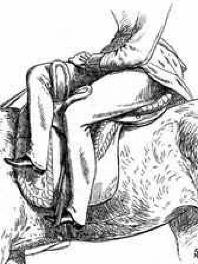
Once in the saddle, the rider placed her right
knee around the stationary horn. Her left knee
was under the down-curved leaping horn, with
her left foot in the stirrup.
*NOTE* Sidesaddles may be made for either
side. In the case of a left, or off-sided
sidesaddle, the instructions above would, of
course, be reversed. There were even some
sidesaddles made that could be fitted with
horns on either side. One of these is mentioned,
by the way, in the novel Dracula.
The tricky part of aside riding was to keep
oneself centered in the saddle. When viewed
from behind, the center back seam of the riderâ
€™s coat had to be directly above the horseâ
€™s tail and spine. In fact, the aside rider
should look no different from her astride
counterpart, except for the absence of a leg on
the right side. Bending to the left or right
caused the horse to be off-balance and could
injure its back.
When confronted with one of the sidesaddles
above, many people still have questions about
the exact way in which the rider gained and sat
in her saddle.
The early Victorian aside rider was
encumbered by her long, flowing skirts. These
caused more difficulty and danger than the
modern rider faces, and made the help of a
friend or groom more necessary. While an
accomplished aside rider could mount unaided,
some women required the help of a gentleman
to give them a “leg up� into the saddle.
(left)
Once in the saddle, the rider placed her right
knee around the stationary horn. Her left knee
was under the down-curved leaping horn, with
her left foot in the stirrup.
*NOTE* Sidesaddles may be made for either
side. In the case of a left, or off-sided
sidesaddle, the instructions above would, of
course, be reversed. There were even some
sidesaddles made that could be fitted with
horns on either side. One of these is mentioned,
by the way, in the novel Dracula.
The tricky part of aside riding was to keep
oneself centered in the saddle. When viewed
from behind, the center back seam of the riderâ
€™s coat had to be directly above the horseâ
€™s tail and spine. In fact, the aside rider
should look no different from her astride
counterpart, except for the absence of a leg on
the right side. Bending to the left or right
caused the horse to be off-balance and could
injure its back.
THE EMERGENCY GRIP & DANGERS
OF ASIDE RIDING
Many 19th century women were expert riders,
as is evidenced by the number of women who
rode saddles without leaping horns. These
riders depended on balance to keep
themselves in the saddle. The leaping horn,
however, made riding much safer. When in
danger, the rider could raise her left knee
under the leaping horn. Thus gripping the two
horns between her legs, she was locked into
the saddle (techniques and opinions about this
vary.)
The risks involved in aside riding lay in three
scenarios. One was the possibility of the
saddle slipping or girth breaking. Another risk
was that a woman might not be able to free
herself if her horse started to fall or got too
restive; the woman's skirts might even wrap
around the saddle horns and cause her to be
dragged along the ground. Finally, a rearing
horse might fall to one side if the rider could
not maintain good balance. These risks, when
combined with the challenges faced by
Western riders, helped to cause the downfall
of the sidesaddle.
OF ASIDE RIDING
Many 19th century women were expert riders,
as is evidenced by the number of women who
rode saddles without leaping horns. These
riders depended on balance to keep
themselves in the saddle. The leaping horn,
however, made riding much safer. When in
danger, the rider could raise her left knee
under the leaping horn. Thus gripping the two
horns between her legs, she was locked into
the saddle (techniques and opinions about this
vary.)
The risks involved in aside riding lay in three
scenarios. One was the possibility of the
saddle slipping or girth breaking. Another risk
was that a woman might not be able to free
herself if her horse started to fall or got too
restive; the woman's skirts might even wrap
around the saddle horns and cause her to be
dragged along the ground. Finally, a rearing
horse might fall to one side if the rider could
not maintain good balance. These risks, when
combined with the challenges faced by
Western riders, helped to cause the downfall
of the sidesaddle.
Position in a 19th Century 3-horn
saddle. Opinions differ as to whether
or not the left knee should be this
high.
saddle. Opinions differ as to whether
or not the left knee should be this
high.
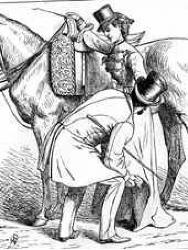

| Mounting with Help |
| Sitting squarely in the Saddle. |