With aside riding now the norm, 19th
century saddlers had incentive to
produce new styles of sidesaddles.
Basically, there were four main types of
sidesaddles during this time period, the
Somerset, the Level-seat Hunting
Saddle; the Ruwart and the Western or
Goodnight saddle.
The Somerset was the oldest, based on
18th century saddles. It featured a
carpeted seat, slipper stirrup and first
horn. Made for light riding, it could be
extremely ornamental. A few examples
featured a bar which ran around the
one side of the saddle. Built on a manâ
€™s tree, however, the Somerset was
not always comfortable. The center of
the seat had a deep dip, so the riderâ
€™s leg in effect went up-hill.
Somerset-types continued to be
produced until the early 20th century.
For the more sophisticated park rider
or hunter, the level-seat saddle was
more popular. Made of leather with
little decoration, this saddle gradually
lost its first horn, but had a sturdy
leaping horn. As its name implied, the
seat of this saddle was almost flat,
making riding more comfortable. Avid
huntresses, such as Empress Elizabeth
of Austria, rode saddles such as this.
The modern hunting sidesaddle, which
features wider horns, is the descendent
of this saddle.
While level-seat saddles tended to be
the property of the wealthy, the Ruwart
tree sidesaddle was designed for riders
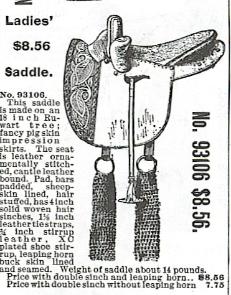
of more modest means. Designed in the
U.S. and built on a specially designed
sidesaddle tree, the Ruwart could be
fitted out in several different ways.
Some styles featured the slipper stirrup
and carpet seat of a Somerset. Some
were more western in appearance, and
some were mixtures of the two. Many
Ruwarts were intended for light riding,
as they had only one girth and lacked
the leaping horn. Sold by catalogs such
as Sears and Montgomery Wards, this
was the type of saddle owned by many
women in the East Texas/Northwest
Louisiana area. This style is commonly
found at flea markets and antique
stores.
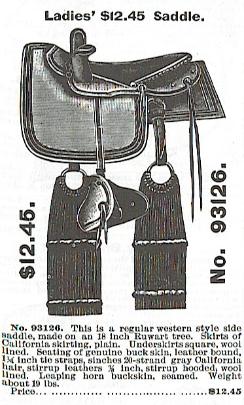
The Goodnight or Western sidesaddle
was, in one sense, America’s
equivalent to the hunting sidesaddle.
According to legend, in the late 19th
century (dates are conflicting) the
Texas rancher Charles Goodnight
designed a sturdy sidesaddle for his
wife to ride on cattle drives. This
saddle featured a modified man’s
western saddletree fitted with horns.
Thus the true “western sidesaddleâ
€� was born. Sturdy and often fitted
with more than one girth, this type of
sidesaddle was distinctively western in
decoration. Some even came with
tapidero stirrups. The original
Goodnight saddle is now the the
Panhandle Plains museum in Canyon,
Texas.
century saddlers had incentive to
produce new styles of sidesaddles.
Basically, there were four main types of
sidesaddles during this time period, the
Somerset, the Level-seat Hunting
Saddle; the Ruwart and the Western or
Goodnight saddle.
The Somerset was the oldest, based on
18th century saddles. It featured a
carpeted seat, slipper stirrup and first
horn. Made for light riding, it could be
extremely ornamental. A few examples
featured a bar which ran around the
one side of the saddle. Built on a manâ
€™s tree, however, the Somerset was
not always comfortable. The center of
the seat had a deep dip, so the riderâ
€™s leg in effect went up-hill.
Somerset-types continued to be
produced until the early 20th century.
For the more sophisticated park rider
or hunter, the level-seat saddle was
more popular. Made of leather with
little decoration, this saddle gradually
lost its first horn, but had a sturdy
leaping horn. As its name implied, the
seat of this saddle was almost flat,
making riding more comfortable. Avid
huntresses, such as Empress Elizabeth
of Austria, rode saddles such as this.
The modern hunting sidesaddle, which
features wider horns, is the descendent
of this saddle.
While level-seat saddles tended to be
the property of the wealthy, the Ruwart
tree sidesaddle was designed for riders
of more modest means. Designed in the
U.S. and built on a specially designed
sidesaddle tree, the Ruwart could be
fitted out in several different ways.
Some styles featured the slipper stirrup
and carpet seat of a Somerset. Some
were more western in appearance, and
some were mixtures of the two. Many
Ruwarts were intended for light riding,
as they had only one girth and lacked
the leaping horn. Sold by catalogs such
as Sears and Montgomery Wards, this
was the type of saddle owned by many
women in the East Texas/Northwest
Louisiana area. This style is commonly
found at flea markets and antique
stores.
The Goodnight or Western sidesaddle
was, in one sense, America’s
equivalent to the hunting sidesaddle.
According to legend, in the late 19th
century (dates are conflicting) the
Texas rancher Charles Goodnight
designed a sturdy sidesaddle for his
wife to ride on cattle drives. This
saddle featured a modified man’s
western saddletree fitted with horns.
Thus the true “western sidesaddleâ
€� was born. Sturdy and often fitted
with more than one girth, this type of
sidesaddle was distinctively western in
decoration. Some even came with
tapidero stirrups. The original
Goodnight saddle is now the the
Panhandle Plains museum in Canyon,
Texas.
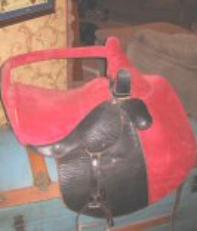
My unusual off-side Somerset
sidesaddle has a balance bar around
one side.
sidesaddle has a balance bar around
one side.
| A Western-style sidesaddle from the Sears 1897 catalog. |
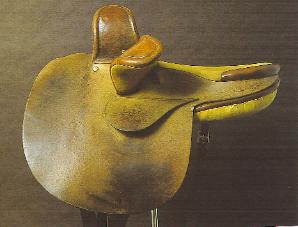
A level-seat sidesaddle with the wider horns
popular in the 20th century, and still used
today.
popular in the 20th century, and still used
today.
| A ruwart-style sidesaddle from the Sears Catalog 1897. This saddle includes the leaping horn; cheaper saddles did not. |