FACING FORWARD
During the late Middle Ages and early
Renaissance, women still rode modified
men’s saddles, but the saddles
themselves had changed in shape. The â
€œgentlemen’sâ€� saddles of the time,
with a small horn in front and a lower cantle
in back, allowed women to ride holding the
reins and facing forward.
During the late Middle Ages and early
Renaissance, women still rode modified
men’s saddles, but the saddles
themselves had changed in shape. The â
€œgentlemen’sâ€� saddles of the time,
with a small horn in front and a lower cantle
in back, allowed women to ride holding the
reins and facing forward.
The image of an aside rider still sparks the imagination
and often raises the practical question of “How does
she stay on like that?�
The answer, of course, is the aside rider’s specially
designed saddle. (No aside riding is NOT quite as easy
as Barbie makes it look in her movies.) The modern
sidesaddle is the result of centuries of experimentation
and modification. Beginning in the Middle Ages, the
sidesaddle passed through several forms before arriving
at the “modern� saddle favored today.
As an artifact, the different forms of the sidesaddle also
reveal a great deal about the cultures which made and
used it. Using the sidesaddle as a springboard, we can
learn about women’s role in society, leisure
pursuits, costume and ideas about modesty.
With this in mind, let’s begin our journey through
the history of aside riding, see the pinnacle of the
sidesaddle's popularity during the 19th century, and see
its decline during the early 20th century.
and often raises the practical question of “How does
she stay on like that?�
The answer, of course, is the aside rider’s specially
designed saddle. (No aside riding is NOT quite as easy
as Barbie makes it look in her movies.) The modern
sidesaddle is the result of centuries of experimentation
and modification. Beginning in the Middle Ages, the
sidesaddle passed through several forms before arriving
at the “modern� saddle favored today.
As an artifact, the different forms of the sidesaddle also
reveal a great deal about the cultures which made and
used it. Using the sidesaddle as a springboard, we can
learn about women’s role in society, leisure
pursuits, costume and ideas about modesty.
With this in mind, let’s begin our journey through
the history of aside riding, see the pinnacle of the
sidesaddle's popularity during the 19th century, and see
its decline during the early 20th century.
ANCIENT AND MEDIEVAL SIDESADDLES
Images of goddesses and women sitting sideways on horses and donkeys are commonly
found in the ancient world. There were no saddles as we know them at this time, only soft
pads and blankets. Few Greek or Roman women rode horseback at all; those who did were
probably led along by a servant or rode on a gentle donkey.
The true saddle, built on a rigid framework called a tree, appeared in the Middle Ages. Most
of the saddles during this time period were designed to meet the needs of knights in combat.
High pommels and cantles (the back and front of the saddle) kept the knight in place while
fighting. These saddles, fitted with a footboard called a planchette, and perhaps a backrest,
made secure sidesaddles. Unfortunately, the design of many of these saddles required that the
woman ride facing sideways, making it difficult for her to hold the reins.
Riding sideways was not a major problem, however, as sidesaddles appear to have been
used mostly for ceremonial purposes during this time period. Riding aside was a great way to
display an elaborate gown.
For more prosaic purposes, women wore divided skirts, or pants under their skirts, and rose
cross-saddle like men.
Images of goddesses and women sitting sideways on horses and donkeys are commonly
found in the ancient world. There were no saddles as we know them at this time, only soft
pads and blankets. Few Greek or Roman women rode horseback at all; those who did were
probably led along by a servant or rode on a gentle donkey.
The true saddle, built on a rigid framework called a tree, appeared in the Middle Ages. Most
of the saddles during this time period were designed to meet the needs of knights in combat.
High pommels and cantles (the back and front of the saddle) kept the knight in place while
fighting. These saddles, fitted with a footboard called a planchette, and perhaps a backrest,
made secure sidesaddles. Unfortunately, the design of many of these saddles required that the
woman ride facing sideways, making it difficult for her to hold the reins.
Riding sideways was not a major problem, however, as sidesaddles appear to have been
used mostly for ceremonial purposes during this time period. Riding aside was a great way to
display an elaborate gown.
For more prosaic purposes, women wore divided skirts, or pants under their skirts, and rose
cross-saddle like men.
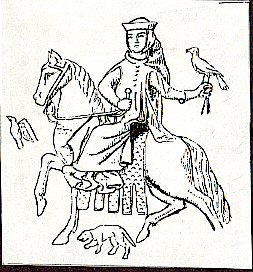
Above: Alix of Brabant rides aside c.
1260. Unlike many Medieval
illustrations, this picture shows the
riderfacing forward. From Les
Costumes Du Moyen Age D'apres
Les Sceaux.
1260. Unlike many Medieval
illustrations, this picture shows the
riderfacing forward. From Les
Costumes Du Moyen Age D'apres
Les Sceaux.
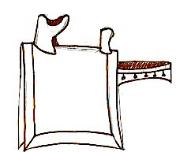
Above: Blanchefleur's Saddle
(redrawn, left-side view) shows the
beginnings of the horn on the
pommel. The cantle is still high and
curved around the rider's body. This
saddle had an ornamental
breast-collar.
(redrawn, left-side view) shows the
beginnings of the horn on the
pommel. The cantle is still high and
curved around the rider's body. This
saddle had an ornamental
breast-collar.
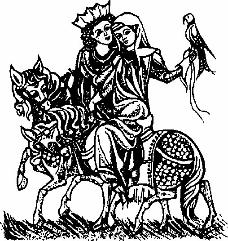
Left: The lady rides astride (cross-saddle) in this
Medieval illustration. Women rode both aside and
astride during the Middle Ages.
Medieval illustration. Women rode both aside and
astride during the Middle Ages.
| HISTORY OF ASIDE RIDING |
Previous Page
It’s a beautiful scene: a white horse
with flowing mane and tail, galloping
along a path toward a stately mansion.
On his back is a young woman, her
long riding skirt rippling in the wind and
her figure enhanced by a tight bodice.
A veiled top-hat rests on her head, and
her gloved right hand carries an ivory
crop. She draws rein in the courtyard
and the spirited animal comes to a halt,
still prancing. A groom comes forward
to take the horse, and the woman
slides lightly to her feet.
with flowing mane and tail, galloping
along a path toward a stately mansion.
On his back is a young woman, her
long riding skirt rippling in the wind and
her figure enhanced by a tight bodice.
A veiled top-hat rests on her head, and
her gloved right hand carries an ivory
crop. She draws rein in the courtyard
and the spirited animal comes to a halt,
still prancing. A groom comes forward
to take the horse, and the woman
slides lightly to her feet.