Women in the 19th and early 20th centuries could choose from several
different types of sidesaddles.
different types of sidesaddles.
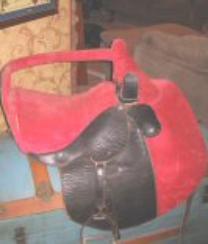
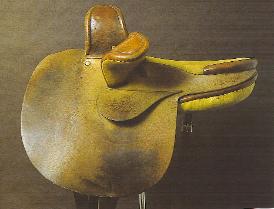
| The Somerset sidesaddle was the oldest type of saddle. It was built on a men's English saddletree (with added horns) and often did not have a leaping horn. The "balance bar" on this saddle is not typical. |
Sidesaddles like this were used for hunting.
They were plain but very strongly built. You
can see that this saddle doesn't have a "first
horn" on the right side and the seat is almost
flat. "Modern" English.sidesaddles look like
this today.
They were plain but very strongly built. You
can see that this saddle doesn't have a "first
horn" on the right side and the seat is almost
flat. "Modern" English.sidesaddles look like
this today.
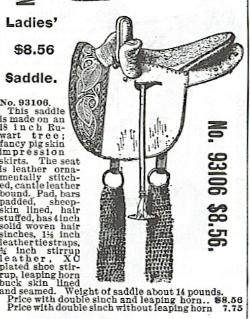
This sidesaddle is built on the Ruwart
saddle tree. Sidesaddles like this were
made in America for middle-class
women. Catalogs from Sears and
Montgomery Wards sold these cheaply.
These saddles often have carpet-covered
seats and sometimes only have 2 horns
(no leaping horn.)
saddle tree. Sidesaddles like this were
made in America for middle-class
women. Catalogs from Sears and
Montgomery Wards sold these cheaply.
These saddles often have carpet-covered
seats and sometimes only have 2 horns
(no leaping horn.)
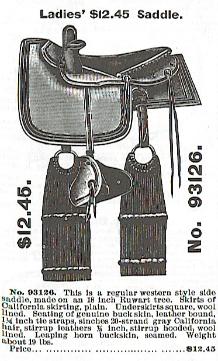
A rancher named Charles Goodnight is said to have
designed the first Western sidesaddle for his wife to
ride. These saddles were very heavily built and were
made for hard riding over rough terrain. Catalogs
sold these saddles as well as Ruwart and
Somersetï¿¿-style saddles.
designed the first Western sidesaddle for his wife to
ride. These saddles were very heavily built and were
made for hard riding over rough terrain. Catalogs
sold these saddles as well as Ruwart and
Somersetï¿¿-style saddles.
Even in the mid-19th century, some women had begun to wear bloomer
costumes and ride men's saddles as their families moved westward. Some
women continued to ride men's saddles once they arrived at their new homes,
while others went back to sidesaddles. Horses in the west were often wild,
though, and the terrain was rough. Riding sidesaddle in the West was more
difficult and dangerous than it was in a park or country road in the East.
During the 1880s, an important invention made it acceptable for women to
wear "divided garments" in public: the bicycle! The bicycle became very
popular, and serious cyclists learned that skirts were dangerous and
impractical. Some women cyclists began to wear bloomers.
At the same time, women began to question why they had to ride horseback in
skirts if they could ride a bicycle in bloomers. Instead of bloomers for
horseback riding, though, American women usually chose to wear divided
skirts when they rode men's saddles. From the side, the divided skirt made it
appear that the woman was riding a sidesaddle. On the ground, the two legs of
the skirt could be buttoned together.
costumes and ride men's saddles as their families moved westward. Some
women continued to ride men's saddles once they arrived at their new homes,
while others went back to sidesaddles. Horses in the west were often wild,
though, and the terrain was rough. Riding sidesaddle in the West was more
difficult and dangerous than it was in a park or country road in the East.
During the 1880s, an important invention made it acceptable for women to
wear "divided garments" in public: the bicycle! The bicycle became very
popular, and serious cyclists learned that skirts were dangerous and
impractical. Some women cyclists began to wear bloomers.
At the same time, women began to question why they had to ride horseback in
skirts if they could ride a bicycle in bloomers. Instead of bloomers for
horseback riding, though, American women usually chose to wear divided
skirts when they rode men's saddles. From the side, the divided skirt made it
appear that the woman was riding a sidesaddle. On the ground, the two legs of
the skirt could be buttoned together.