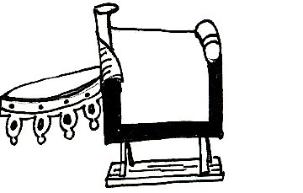
As the years went by, wealthy
women and noble women
continued to ride sidesaddle on
special occasions. On the right is a
drawing of Queen Elizabeth I of
England's sidesaddle. It has one
horn in the middle of the pommel
(the front).
At some point, a women discovered
that if she bent her right knee
around the saddlehorn, she could sit
more securely on the saddle.
women and noble women
continued to ride sidesaddle on
special occasions. On the right is a
drawing of Queen Elizabeth I of
England's sidesaddle. It has one
horn in the middle of the pommel
(the front).
At some point, a women discovered
that if she bent her right knee
around the saddlehorn, she could sit
more securely on the saddle.
Over time, someone added another horn to the saddle. Now sidesaddles had two
horns, one on each side of the pommel.
horns, one on each side of the pommel.
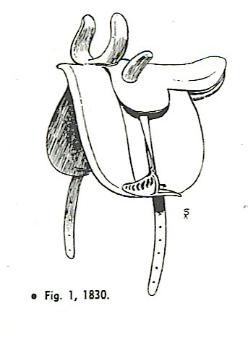
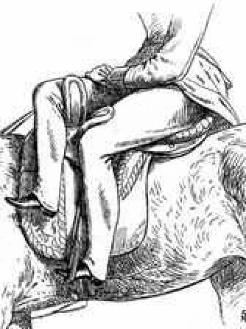
| By the late 18th Century (the 1700s) a more modern-looking sidesaddle had been developed. This sidesaddle had two horns. The horn on the far right (if you were seated in the saddle) was called the first horn. The horn on the left was called the second horn or stationary horn. Many women rode these saddles, although if the horse bucked or even trotted hard the rider might bounce off the saddle. Even in the 18th Century some royal women rode on men's saddles. During the 19th Century (1800s), however, most people did not consider it appropriate for women to wear pants or to ride like men. Women rode horseback wearing riding habits with long, flowing skirts. In the 1830s a new invention made sidesaddles much safer to ride. This new invention was called the "leaping horn." The leaping horn is the horn on the far left of a sidesaddle. It can spin around, so that it fits over the rider's left knee. If the horse jumps or bucks, the rider can squeeze her legs together to hold onto the saddlehorns. Right: This picture shows how a woman sat in a sidesaddle. Of course, her skirt would normally cover her legs. The tricky part of aside riding was keeping your weight in the center of the saddle. You couldn't lean to one side, or the horse might get a sore back. |
This sidesaddle has a leaping horn. The
stirrup is called a "slipper stirrup"- it
looks like a shoe.
stirrup is called a "slipper stirrup"- it
looks like a shoe.
Women did fall off of sidesaddles,
of course, but it was harder to do
than you might think!
The real danger in aside riding was
that your long skirt might get
wrapped around the saddlehorns and
the horse might drag you, or that the
horse might fall on you if he reared
up.
of course, but it was harder to do
than you might think!
The real danger in aside riding was
that your long skirt might get
wrapped around the saddlehorns and
the horse might drag you, or that the
horse might fall on you if he reared
up.