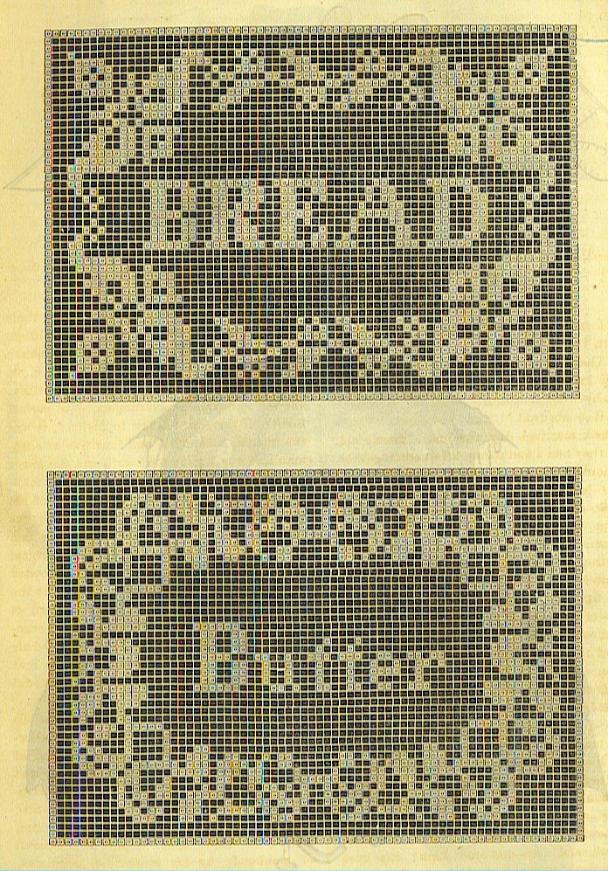
Bread & Butter Cloths: March 1867
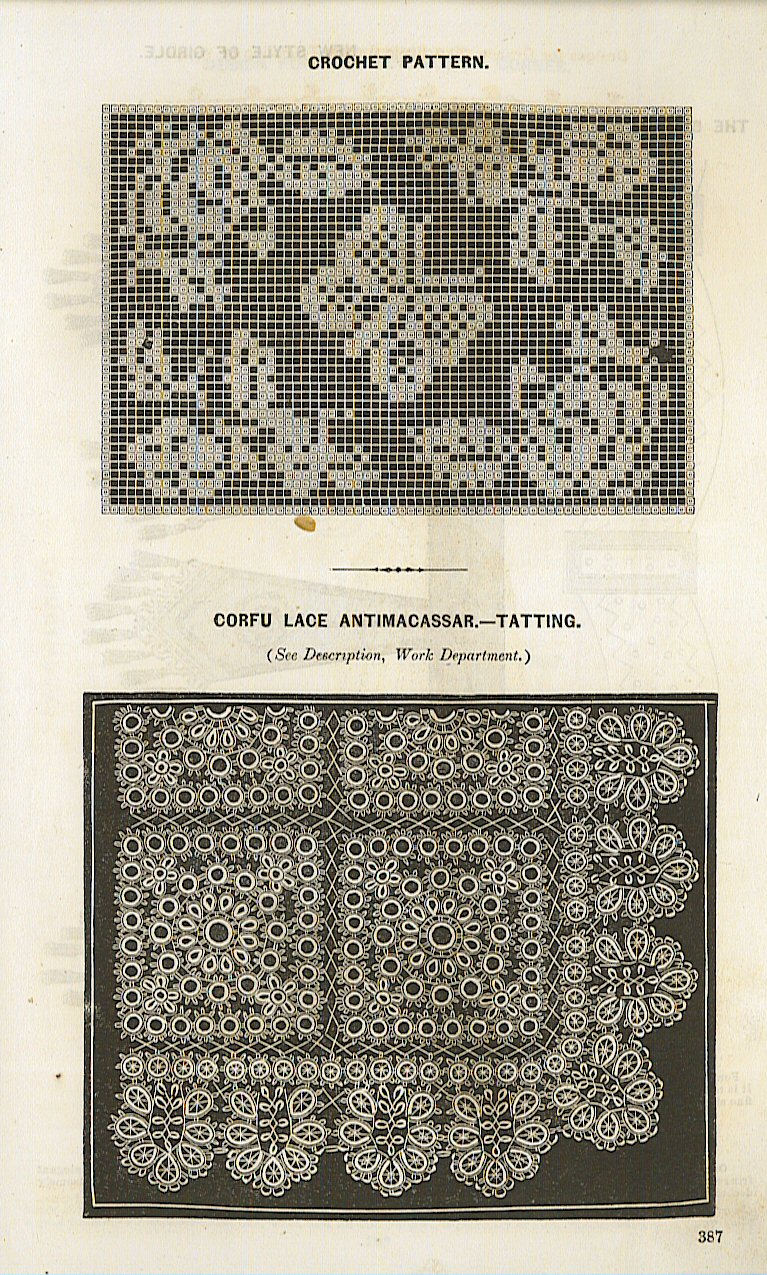
Butterfly Filet & Tatting Pattern: Nov. 1867
Filet Crochet Patterns
NOTE: For those of you unfamilar with filet crochet, its
method of working is quite easy once understood. The
patterns are made of "blocks" filled in by double-crochets,
and open "spaces." If you are not familiar with single
crochets (sc) chain stitches (ch) and double crochet
stitches (dc), review these first.
Spaces in most patterns I've used are 2 stitches wide, with
a stitch (usually a dc) on either side acting as the vertical
"bar". You can vary this to make the spaces larger, using
treble stitches and more chains if you want to experiment.
See the photo at right for a visual image of how the
stitches look (although this photos is sideways....oops!)
First, crochet a chain as the base. You will need to count
the squares along one edge (usually the lower edge) of the
pattern. Multiply this by 3 and then add one extra stitch.
This is your base chain. Be sure and note which is the last
chain in your base chain.
You now turn your work and work back again over the
base chain. What you do now will depend on your first
block/space. If you need to make a block first, as you
would in the pattern on the left, you'd need to crochet 3 ch
to turn, then crochet a dc in the last chain of the base chain
you made previously. Now make dcs in the next 3 chains
of the base chain. This is one block (2 dc in the center
with a dc on each side acting as "bars."
If you need to make a space first, sc 5 stitches to turn, (3
stitches count as a dc and 2 stitches to bridge the space.
Now made a dc in the 4th chain on the base chain. This
makes the first space: an open space 2 stitches wide with
bars on either side.
Now that you have begun, you will continue to make
blocks of 4 dc (2 dc in the center to fill in the block, and a
dc on each side as a bar).
Spaces are made with a dc made into stitch below, then 2
ch stitches to bridge the space, (skip 2 stitches on the row
below) then dc into the next stitch below.
At the end of each row it is necessary to chain a few
stitches to turn. Chain 3 stitches if you will be making a
block first; 5 stitches if you're making a space first.
Each row is worked, of course, exactly over the one
below it. Filet makes beautiful patterns, is easy to do, and
looks great framed!
method of working is quite easy once understood. The
patterns are made of "blocks" filled in by double-crochets,
and open "spaces." If you are not familiar with single
crochets (sc) chain stitches (ch) and double crochet
stitches (dc), review these first.
Spaces in most patterns I've used are 2 stitches wide, with
a stitch (usually a dc) on either side acting as the vertical
"bar". You can vary this to make the spaces larger, using
treble stitches and more chains if you want to experiment.
See the photo at right for a visual image of how the
stitches look (although this photos is sideways....oops!)
First, crochet a chain as the base. You will need to count
the squares along one edge (usually the lower edge) of the
pattern. Multiply this by 3 and then add one extra stitch.
This is your base chain. Be sure and note which is the last
chain in your base chain.
You now turn your work and work back again over the
base chain. What you do now will depend on your first
block/space. If you need to make a block first, as you
would in the pattern on the left, you'd need to crochet 3 ch
to turn, then crochet a dc in the last chain of the base chain
you made previously. Now make dcs in the next 3 chains
of the base chain. This is one block (2 dc in the center
with a dc on each side acting as "bars."
If you need to make a space first, sc 5 stitches to turn, (3
stitches count as a dc and 2 stitches to bridge the space.
Now made a dc in the 4th chain on the base chain. This
makes the first space: an open space 2 stitches wide with
bars on either side.
Now that you have begun, you will continue to make
blocks of 4 dc (2 dc in the center to fill in the block, and a
dc on each side as a bar).
Spaces are made with a dc made into stitch below, then 2
ch stitches to bridge the space, (skip 2 stitches on the row
below) then dc into the next stitch below.
At the end of each row it is necessary to chain a few
stitches to turn. Chain 3 stitches if you will be making a
block first; 5 stitches if you're making a space first.
Each row is worked, of course, exactly over the one
below it. Filet makes beautiful patterns, is easy to do, and
looks great framed!

Sorry...I forgot to turn this image
around, so you're looking at it
SIDEWAYS. When you're working
the dc blocks should be
straight-up-and-down. But this might
help you visualize how the blocks are
formed.
This is part of a larger filet piece of
roses.
around, so you're looking at it
SIDEWAYS. When you're working
the dc blocks should be
straight-up-and-down. But this might
help you visualize how the blocks are
formed.
This is part of a larger filet piece of
roses.