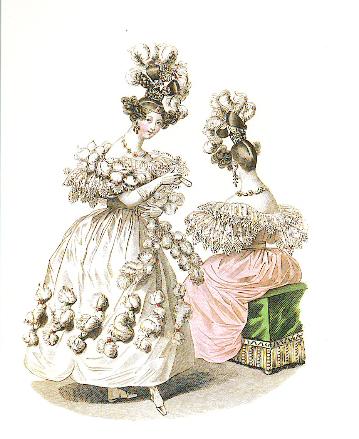
This style is from the early 1830s. You can see how
different it is from the dresses a decade earlier.
"Romantic" dresses like the one on the left had very large
sleeves. The sleeves were made to look even larger by ruffles
and lace. The waist-line on this dress is still a little higher than
normal. The skirt is gathered very full into the waistband, and
is ankle-length.
Notice the woman's ballet-type slippers. It was during this
period that ballerinas began to dance on pointe (toe.) It's not
known whether they simply modified common slippers as
dancing shoes, of if ballet slippers became popular because of
the success of the early ballerinas.
The dress on the left is a ball gown, and the woman's hair is
styled in an elaborate coiffure with feathers and jewels. False
hair may have helped create this hairstyle. One of the popular
hairstyles during the 1830s was the "giraffe" hairstyle!
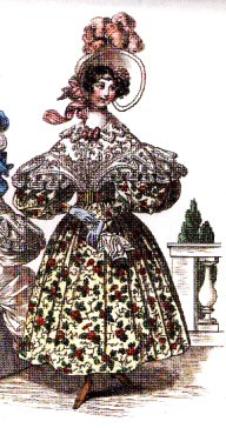
The dress on the right is a day dress. You can see that the
upper part of the dress is covered by a white pelerine with
large ruffles over the sleeves.. The skirt is ankle-length. The
woman wears a large bonnet and gloves for going outdoors.
different it is from the dresses a decade earlier.
"Romantic" dresses like the one on the left had very large
sleeves. The sleeves were made to look even larger by ruffles
and lace. The waist-line on this dress is still a little higher than
normal. The skirt is gathered very full into the waistband, and
is ankle-length.
Notice the woman's ballet-type slippers. It was during this
period that ballerinas began to dance on pointe (toe.) It's not
known whether they simply modified common slippers as
dancing shoes, of if ballet slippers became popular because of
the success of the early ballerinas.
The dress on the left is a ball gown, and the woman's hair is
styled in an elaborate coiffure with feathers and jewels. False
hair may have helped create this hairstyle. One of the popular
hairstyles during the 1830s was the "giraffe" hairstyle!
The dress on the right is a day dress. You can see that the
upper part of the dress is covered by a white pelerine with
large ruffles over the sleeves.. The skirt is ankle-length. The
woman wears a large bonnet and gloves for going outdoors.
In 1837 the young and beautiful Victoria came to the throne
of England. In the past, some of the rulers of England had led very
wild lifestyles. The young Victoria tried to live a moral,
family-oriented Christian life.
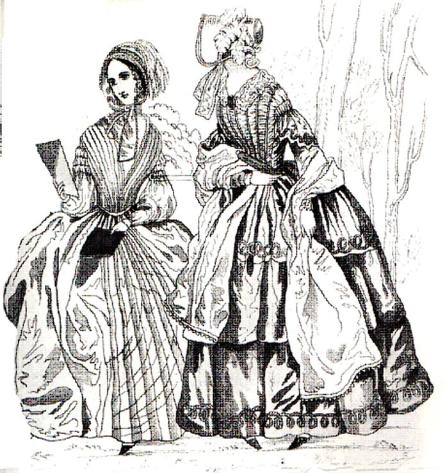
The dresses of the late 1830s and early 1840s reflected this
change in values. They were more demure, sedate and modest, and
they were usually made in more sober colors and heavier fabrics.
The dresses on the left were featured in the November 1842 issue
of Godey's Lady's Book
Some of the characteristics of dresses in the 1840s are:
Sleeves that are tight at the top but balloon-out on the forearm
Long-waisted bodices
Long skirts
Bonnets that hide the face from the side
Spaniel curls (Long curls on either side of the face) were popular
of England. In the past, some of the rulers of England had led very
wild lifestyles. The young Victoria tried to live a moral,
family-oriented Christian life.
The dresses of the late 1830s and early 1840s reflected this
change in values. They were more demure, sedate and modest, and
they were usually made in more sober colors and heavier fabrics.
The dresses on the left were featured in the November 1842 issue
of Godey's Lady's Book
Some of the characteristics of dresses in the 1840s are:
Sleeves that are tight at the top but balloon-out on the forearm
Long-waisted bodices
Long skirts
Bonnets that hide the face from the side
Spaniel curls (Long curls on either side of the face) were popular
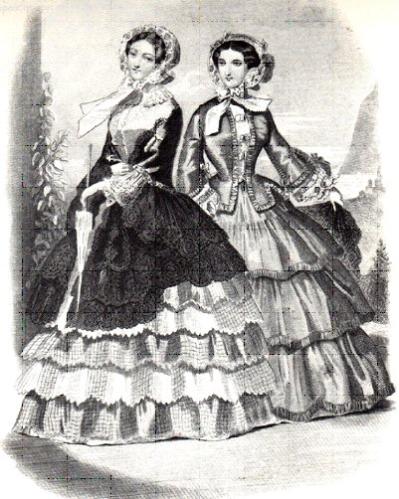
Skirts gradually became fuller and fuller. Sometimes as many as eight
petticoats (underclothes) were used to hold the skirts out. In the late
1850s, the hoopskirt, or cage crinoline, appeared. This underskirt was
made of wire hoops connected together by tapes. With the hoopskirt, women
no longer needed to wear so many petticoats. Skirts became larger and larger.
Women in the 1850s wanted a "rounded," plump look to their bodies. Being
too thin wasn't popular!
Some of the characteristics of 1850s dresses were:
Long skirts made of tiers of ruffles (flounces)
Sleeves that were wide at the wrist, to show off decorative undersleeves.
Wide bonnets that showed the face.
Fashionable hairstyle: Parted in the center and the sidehair shaped into "puffs."
Shawls
The dresses on the right are from an 1855 Godey's Lady's Book (magazine.)
petticoats (underclothes) were used to hold the skirts out. In the late
1850s, the hoopskirt, or cage crinoline, appeared. This underskirt was
made of wire hoops connected together by tapes. With the hoopskirt, women
no longer needed to wear so many petticoats. Skirts became larger and larger.
Women in the 1850s wanted a "rounded," plump look to their bodies. Being
too thin wasn't popular!
Some of the characteristics of 1850s dresses were:
Long skirts made of tiers of ruffles (flounces)
Sleeves that were wide at the wrist, to show off decorative undersleeves.
Wide bonnets that showed the face.
Fashionable hairstyle: Parted in the center and the sidehair shaped into "puffs."
Shawls
The dresses on the right are from an 1855 Godey's Lady's Book (magazine.)
Both of these dresses are from French Fashion Plates of the Romantic
Era in Full Color. (A reprint by Dover Books)
Era in Full Color. (A reprint by Dover Books)